ND Pride Science Conference
11 junio, 2026 9 de la mañana - 21.00 h
Sitio Web: Ver Sitio Web del Evento
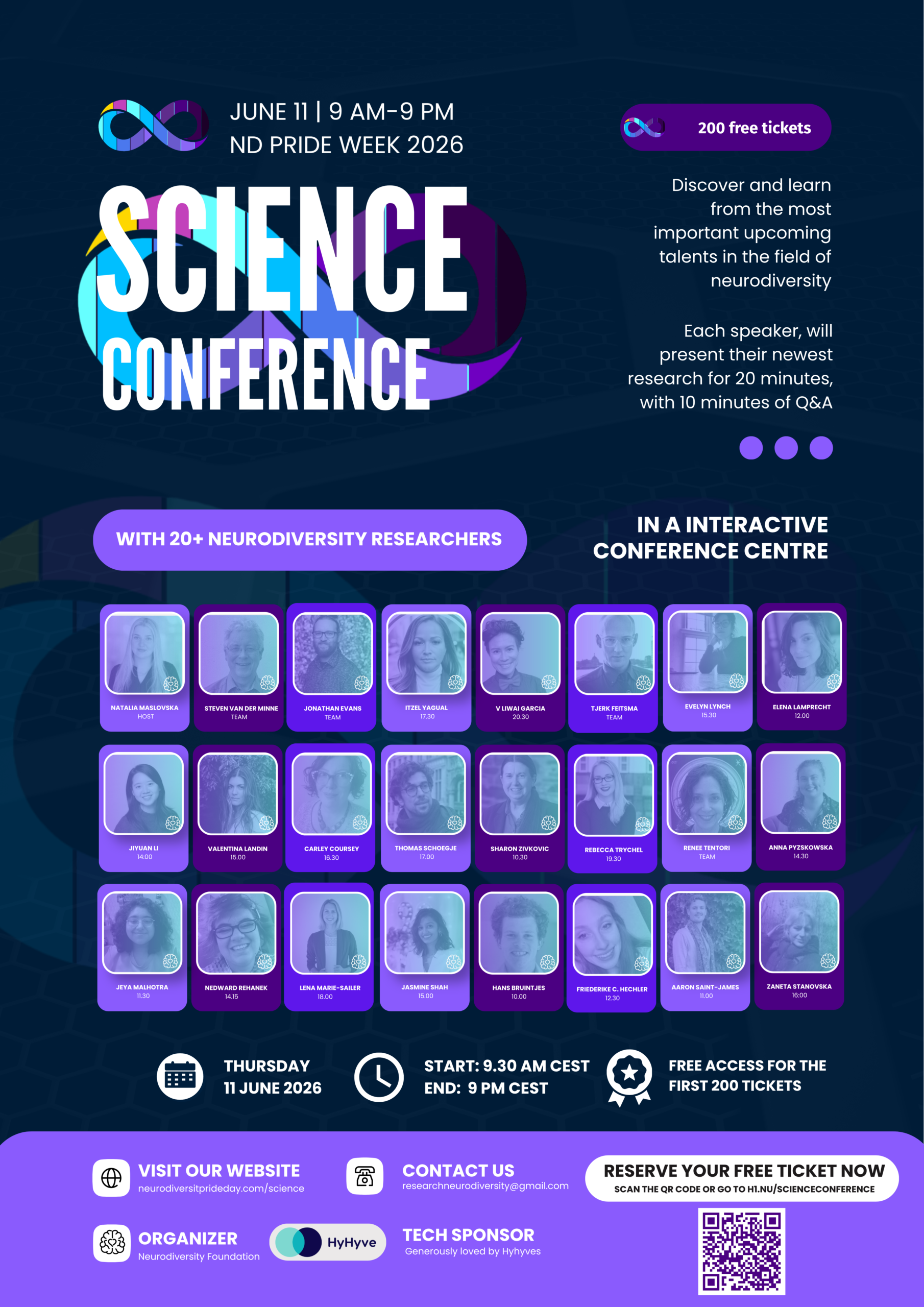
Thursday 11 June 2026 | Online in Hyhyve | CEST / Amsterdam time
Reserve your free ticket: h1.nu/scienceconference
More information: neurodiversityprideday.com/science
The Science Conference opens Neurodiversity Pride Week 2026 with a full day of research, lived experience, creativity, policy, education, workplace insight, and neurodivergent-led knowledge. Across the day, more than 20 speakers from around the world will share their newest research and ideas on neurodiversity: not as a problem to be solved, but as a source of knowledge, identity, culture, creativity, and social change.
This online conference takes place in Hyhyve, an interactive digital conference centre. This means you can watch the presentations, but also walk around, meet other participants, have conversations, and experience the day more like a real conference environment than a regular livestream.
Each speaker will present for approximately 20 minutes, followed by 10 minutes of Q&A. There will be a lunch break from 13:00 to 14:00 and a dinner break from 18:30 to 19:30, with no presentations scheduled during those times.
Tickets are free, with free access for the first 200 participants.
09:00 – Walk-in
Participants can enter the Hyhyve conference space, explore the online environment, and get ready for the day.
09:30 – Opening by the Science Conference team
The team welcomes participants, introduces the purpose of the Science Conference, and explains how the day will work.
10:00 – Hans Bruintjes
Hans Bruintjes explores discrimination against neurodivergent people in education, the labour market, government action, and legal protection, connecting personal stories with policy, law, and practical change.
10:30 – Sharon Zivkovic
Sharon Zivkovic presents her work on supporting autistic social entrepreneurs, focusing on how disability, business, and social enterprise support services can become more strengths-based and neurodiversity-affirming.
11:00 – Aaron Saint-James
Aaron Saint-James examines Universal Design for Learning in Australian higher education, asking how universities can move from accessibility in policy language to accessibility in real everyday practice.
11:30 – Jeya Malhotra
Jeya Malhotra shares a cross-cultural study of pedagogical approaches for neurodivergent children, exploring how inclusive education can be measured, compared, and improved across different contexts.
12:00 – Elena Lamprecht
Elena Lamprecht investigates hallucinations in neurodiverse populations through sensory, trauma-informed, genetic, and cultural perspectives, with the aim of improving understanding and support.
12:30 – Friederike Charlotte Hechler
Why can eating become such a complex part of everyday life for autistic people? Friederike Charlotte Hechler presents preliminary findings from a mixed-methods study exploring the challenges, consequences, and coping strategies associated with atypical eating, drawing on autistic people’s own experiences and perspectives.
13:00 – 14:00 – Lunch break
There are no presentations during this hour. Participants can rest, eat, explore Hyhyve, or connect with others.
14:00 – Jiyuan Li
Jiyuan Li opens the afternoon programme with a contribution to the wider conference conversation on neurodiversity, research, lived experience, and social change.
14:15 – Nedward WD Rehanek
Nedward WD Rehanek discusses neurodiversity, madness, disability, art, and games, showing how game design can become a powerful medium for self-expression and representation.
14:30 – Anna Pyzskowska
Anna Pyzskowska contributes to the conference programme as part of the international group of emerging neurodiversity researchers and thinkers.
15:00 – Jasmine Shah & Valentina Landin
Jasmine Shah and Valentina Landin present their work on creative communication tools for neuroinclusive workplaces, exploring how colour, symbols, metaphors, and co-design can support cross-neurotype dialogue.
15:30 – Evelyn Lynch
Evelyn Lynch explores identity, early misidentification, masking, and unmasking, asking what it means to discover yourself when the labels given in childhood never matched your lived experience.
16:00 – Žaneta Stanovská
Žaneta Stanovská examines neurodivergent artistry, embodied cognition, and creative collaboration, showing how neurodivergent creative processes can challenge deficit narratives and expand our understanding of sociality.
16:30 – Carly Coursey
Carly Coursey presents an oral history study of neurodivergent employment, comparing lived experiences of work with the dominant narratives found in academic research.
17:00 – Thomas Schoegje
Thomas Schoegje explores cognitive fingerprints, workplace fit, and conversational agents, asking how people can better understand how their minds work and how technology may support neurodiverse working lives.
17:30 – Itzel Yagual
Itzel Yagual shares research on neurodivergent women’s work and non-work relationships, communication landscapes, role overload, and the conditions needed for sustainable belonging.
18:00 – Lena-Marie Sailer
Lena-Marie Sailer examines how organisations engage with neurodiversity in practice, looking beyond hiring toward employee networks, internal communities, and everyday workplace inclusion.
18:30 – 19:30 – Dinner break
There are no presentations during this hour. Participants can take a proper break before the evening programme begins.
19:30 – Rebecca Trychel
Rebecca Trychel explores neurodiversity within early educational systems, drawing on education and family policy research to ask how support is delivered and how systems can become more responsive.
20:00 – V Liwai Garcia
V Liwai Garcia presents research on disclosure, power, retaliation, and resilience for Autistic and AuDHD leaders, asking what it costs to lead while disabled and how workplaces can become safer.
20:30 – Closing
The Science Conference closes with a short reflection on the day, the questions raised, and the wider meaning of science within Neurodiversity Pride Week.
The Science Conference is part of Neurodiversity Pride Week 2026. It brings together researchers, lived-experience experts, educators, advocates, artists, designers, and systems thinkers from around the world. The programme moves across many fields: legal protection, autistic entrepreneurship, inclusive education, hallucinations and sensory experience, neurodivergent artistry, game design, workplace communication, employment, unmasking, disclosure, leadership, cognitive fingerprints, relationships, and the future of neuroinclusive workplaces.
Together, these presentations show how wide, urgent, and alive the field of neurodiversity research has become. They also show why research matters most when it is connected to dignity, community, lived experience, and real-world change.
Join us online on 11 June 2026 for a full day of learning, connection, and neurodivergent-led insight.
Contacto: researchneurodiversity@gmail.com


